
Water Heater Installation in Denver, CO
Sewer Lines Plus installs tankless water heaters for residential properties across the Denver metro area. A tankless unit, also called an on demand water heater, heats water as it flows through the system instead of storing it in a tank. This eliminates standby energy loss and delivers continuous hot water to multiple fixtures simultaneously.
Denver creates specific installation requirements that affect tankless sizing, performance, and infrastructure. Altitude at 5,280 feet derates gas BTU output by approximately 20%, which reduces flow rate capacity on every gas tankless unit. Hard water at 15 to 20 grains per gallon requires annual descaling to prevent heat exchanger failure. Cold winter inlet water temperatures (40F to 50F) demand a higher temperature rise than warmer climates, further reducing effective flow rates.
Every tankless installation begins with a free estimate, transparent pricing, and a written scope of work. Our estimators are not paid on commission and recommend only necessary upgrades.
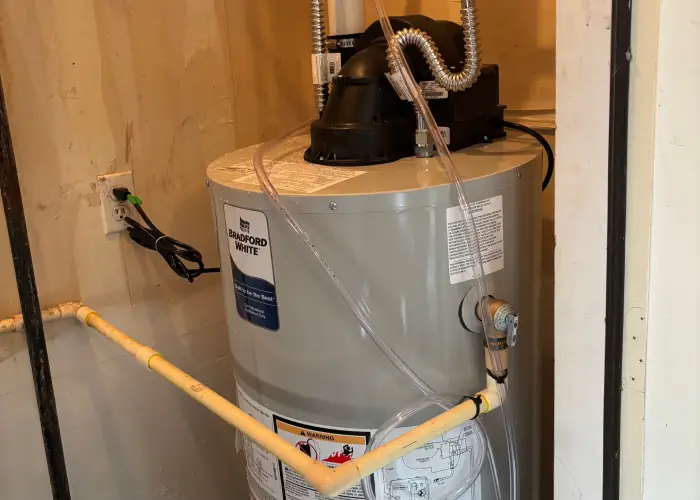
Tank vs Tankless Water Heater Comparison
Choosing between a tank and tankless water heater depends on household demand, installation infrastructure, and long term operating cost. The comparison table below shows how each system performs across the factors that matter most to Denver homeowners.
Feature | Tank Water Heater | Tankless Water Heater |
Hot Water Delivery | Limited to tank capacity (40 to 75 gallons) | Continuous, unlimited at rated flow rate |
Energy Efficiency (UEF) | 0.58 to 0.65 (gas), 0.90 to 0.95 (electric) | 0.80 to 0.97 (gas), 0.98+ (electric) |
Lifespan | 8 to 12 years | 15 to 20 years |
Standby Energy Loss | Yes (heats water 24/7 whether used or not) | None (heats only when a fixture opens) |
Physical Size | Floor standing, 60+ inches tall | Wall mounted, size of a carry on suitcase |
Upfront Cost (Installed) | $1,100 to $2,500 | $3,500 to $6,500+ |
Annual Operating Cost | $350 to $450 (gas) | $200 to $300 (gas) |
Denver Altitude Impact | 20% BTU derating, slower recovery | 20% BTU derating, reduced max flow rate |
Tankless water heaters cost more upfront but deliver lower operating costs, longer lifespan, and zero standby energy loss. Homeowners with high simultaneous demand (multiple showers, dishwasher, laundry) benefit most from the continuous hot water delivery. Smaller households with low simultaneous demand may find a tank water heater meets their needs at a lower upfront cost.
Homeowners choosing a tank system can learn more about water heater installation in Denver.

Gas, Electric, and Condensing Tankless Water Heaters
Three tankless water heater types serve Denver homes. Each type has distinct installation requirements, efficiency ratings, and performance characteristics at altitude.
- Gas Tankless (Non Condensing). Heats water using a gas burner and heat exchanger. UEF range: 0.80 to 0.85. Requires category III stainless steel venting through the roof or an exterior wall. Most common type for Denver homes with existing gas service. Popular models include Rinnai RU199 and Navien NPE series. At 5,280 feet, gas BTU output is derated by 20%, reducing maximum flow rate from the manufacturer’s sea level rating.
- Gas Tankless (Condensing). Captures exhaust heat through a secondary heat exchanger, reaching UEF 0.90 to 0.97. Vents with PVC pipe (no stainless steel required), reducing venting cost. Produces acidic condensate that requires a drain line. Condensing units extract more heat per BTU, partially offsetting Denver altitude derating. Navien NPE A2 and Rinnai RUR are leading condensing models.
- Electric Tankless. Heats water using electrical resistance elements. UEF 0.98+. No venting required. Requires a dedicated 200 amp electrical panel and multiple 40 to 60 amp circuits, which often exceeds existing residential wiring capacity. Best suited for point of use applications (single bathroom, kitchen sink) rather than whole home heating in Denver. No altitude derating applies to electric units.
Sizing a Tankless Water Heater for Denver Altitude
Tankless water heater sizing requires two calculations: total flow rate demand (GPM) and temperature rise. Denver altitude and cold inlet water temperatures make both calculations more demanding than national averages.
Flow Rate Calculation
Add the flow rates of all fixtures that run simultaneously during peak demand. Common fixture flow rates:
Fixture | Flow Rate (GPM) |
Shower | 2.0 to 2.5 |
Kitchen faucet | 1.0 to 1.5 |
Bathroom faucet | 0.5 to 1.0 |
Dishwasher | 1.0 to 1.5 |
Washing machine | 1.5 to 2.0 |
A household running two showers (4.0 GPM) and a kitchen faucet (1.5 GPM) simultaneously needs a unit rated for 5.5 GPM at the required temperature rise.
Temperature Rise at Denver Altitude
Temperature rise equals the desired output temperature minus the incoming water temperature. Denver incoming water temperatures average 40F to 50F in winter. At a desired output of 110F, the required temperature rise is 60F to 70F. This is 15F to 25F higher than the temperature rise in southern states, which reduces the effective flow rate of every unit.
Altitude Derating
Gas tankless water heaters lose approximately 4% of rated BTU output per 1,000 feet above sea level. At Denver altitude (5,280 feet), a gas unit operates at roughly 80% of its sea level BTU rating. A unit rated at 199,000 BTU at sea level delivers approximately 159,000 BTU in Denver. This directly reduces the maximum GPM the unit can deliver at the required temperature rise. Condensing units partially offset this loss by recapturing exhaust heat.
Gas Line and Venting Requirements
Tankless water heater installation often requires infrastructure upgrades beyond the existing tank water heater setup. These requirements account for a significant portion of the installation cost.
- Gas Line Sizing. Most gas tankless units require a 3/4 inch or 1 inch gas supply line. Existing tank water heaters typically connect to a 1/2 inch gas line, which cannot deliver sufficient gas volume for a tankless unit. Gas line upsizing runs from the meter to the unit location. Xcel Energy may need to verify meter capacity.
- Venting (Non Condensing). Non condensing gas tankless units require category III stainless steel venting. Vent pipe routes through the roof or an exterior wall. Stainless steel vent pipe and fittings cost more than standard B vent used for tank water heaters. Maximum vent run length varies by model and diameter.
- Venting (Condensing). Condensing units vent with schedule 40 PVC or CPVC pipe, significantly reducing material cost. A concentric (coaxial) vent brings combustion air in through the outer pipe and exhausts through the inner pipe, allowing installation on an exterior wall with a single penetration.
- Condensate Drain. Condensing units produce acidic condensate that must drain to a floor drain, condensate pump, or exterior discharge point. The condensate line must be routed with proper slope and cannot discharge onto landscaping without a neutralizer.
- Electrical. Gas tankless units require a dedicated 120V outlet near the unit for the electronic control board and ignition system. This is a standard outlet, not the high amperage circuit required by electric tankless units.
Benefits of Tankless Water Heater Installation
Tankless water heater installation delivers measurable improvements in hot water performance, energy efficiency, and equipment lifespan for Denver homeowners.
Continuous Hot Water
A properly sized tankless unit delivers unlimited hot water at the rated flow rate. Multiple showers, dishwasher, and laundry run simultaneously without temperature drops or recovery delays.
30% to 50% Energy Savings
Eliminating standby energy loss reduces annual water heating costs by 30% to 50% compared to a standard gas tank. A condensing tankless unit (0.90 to 0.97 UEF) saves $100 to $200 per year in operating costs over a standard tank (0.58 to 0.65 UEF).
15 to 20 Year Lifespan
Tankless units last 15 to 20 years with annual descaling, nearly double the 8 to 12 year lifespan of a tank water heater. In Denver hard water, annual descaling is essential to reach full lifespan.
Space Savings
A wall mounted tankless unit frees up the floor space occupied by a 60+ inch tall tank water heater. This reclaims usable space in utility closets, basements, and mechanical rooms.
Reduced Water Damage Risk
No storage tank means no risk of a 40 to 80 gallon tank failure flooding the mechanical room, basement, or living space above.
Rebate and Tax Credit Eligibility
High efficiency tankless water heaters may qualify for Xcel Energy rebates and federal tax credits under the Inflation Reduction Act (up to $2,000 for qualifying units). Verify current rebate amounts at xcelenergy.com and energystar.gov before purchasing.
Our Tankless Water Heater Installation Process
Sewer Lines Plus follows a thorough process on every tankless installation. Our estimators are not paid on commission, and our pricing is transparent with no tricks or hidden charges.
Schedule a no wait appointment
Contact our team by phone or online form. We confirm a specific arrival window so homeowners are not waiting for a technician.
Free on site evaluation
A licensed plumber evaluates the installation location, counts fixtures and simultaneous demand, checks gas line size and meter capacity, inspects existing venting, and assesses electrical requirements. We walk through every finding and answer every question.
Detailed written estimate
We present unit options (condensing vs non condensing, brand comparison) with installed cost, including gas line upgrades, venting, condensate drain, permit fees, and old unit disposal. No pressure, no surprises.
Old unit removal and infrastructure upgrades
Our plumber removes and recycles the old tank water heater, then completes gas line upsizing, vent routing, condensate drain, and electrical work before mounting the new unit.
Unit installation and configuration
The tankless unit is wall mounted, connected to gas, water, and electrical, then programmed for Denver conditions: output temperature, recirculation settings (if equipped), and freeze protection activation.
Flow testing and inspection scheduling
We test hot water delivery at every fixture simultaneously, verify flow rates, check for gas leaks at every connection, confirm proper venting draft, and schedule the final code inspection.
Why Denver Homeowners Choose Sewer Lines Plus
Our tagline is “ethics matter.” That philosophy shows in how we evaluate, estimate, and install every tankless water heater.
Free Estimates and Second Opinions
Every tankless installation begins with a free on site evaluation. Homeowners who received a quote from another company receive a free second opinion with a detailed written comparison.
Over 800 Five Star Reviews
Denver metro homeowners have left over 800 verified five star reviews based on transparent pricing, clear communication, and installations completed as quoted.
No Pressure Sales
Our estimators are not paid on commission. They evaluate infrastructure needs, present condensing and non condensing options with honest cost comparisons, and recommend only necessary upgrades.
Licensed and Fully Insured
Every plumber on our team is licensed and covered by general liability and workman’s compensation insurance. Licensed installation validates the manufacturer warranty.
Clear Communication
We explain the altitude derating, gas line requirements, venting options, and cost tradeoffs before quoting. No tricks, no gimmicks, no hidden charges.
Old Unit Disposal Included
We remove and recycle the old water heater as part of every tankless installation at no extra charge.
Tankless Water Heater Installation FAQs
How much does tankless water heater installation cost in Denver?
Tankless water heater installation in Denver ranges from $3,500 to $6,500 or more depending on unit type, gas line upgrades, venting requirements, and installation complexity. Gas line upsizing and new venting account for the largest variable cost.
Can I convert from a tank water heater to tankless?
Yes. Tank to tankless conversion requires a gas line upgrade (1/2 inch to 3/4 inch or 1 inch), new venting (stainless steel or PVC depending on unit type), and a dedicated 120V outlet. Sewer Lines Plus handles the full conversion in one appointment.
Do tankless water heaters work at Denver altitude?
Yes. Gas tankless units operate at approximately 80% of their sea level BTU rating at 5,280 feet. Proper sizing accounts for this derating by selecting a unit with higher BTU input. Condensing units partially offset the loss by recapturing exhaust heat.
What brands of tankless water heaters does Sewer Lines Plus install?
We install all major tankless brands including Rinnai, Navien, Noritz, and Rheem. We recommend Rinnai and Navien condensing units for Denver homes based on altitude performance, parts availability, and warranty coverage.
How long does tankless water heater installation take?
A standard tankless installation takes 4 to 6 hours. Installations requiring gas line upsizing, new venting runs, or electrical work take 6 to 8 hours. Most installations are completed in a single day.
Does a tankless water heater need annual maintenance in Denver?
Yes. Denver hard water at 15 to 20 GPG requires annual descaling to remove mineral buildup from the heat exchanger. Skipping descaling leads to reduced efficiency, error codes, and eventual heat exchanger failure. Learn more about water heater maintenance and flushing in Denver.