
Water Heater Maintenance and Flushing in Denver, CO
Sewer Lines Plus provides water heater maintenance and flushing services for residential properties across the Denver metro area. Annual maintenance removes sediment, inspects critical components, tests safety devices, and extends water heater lifespan by 3 to 5 years.
Denver water conditions make maintenance more urgent than most markets. Hard water at 15 to 20 grains per gallon deposits calcium carbonate inside the tank 2 to 3 times faster than regions with soft water. This sediment hardens on the tank floor, insulates the heating element or burner from the water, and reduces heating efficiency by 10% to 15% per inch of buildup. Without annual flushing, sediment accumulation leads to popping sounds, temperature loss, higher energy bills, and premature tank failure.
Every maintenance service begins with a free estimate, transparent pricing, and a complete written condition report. Our estimators are not paid on commission and recommend only necessary work.
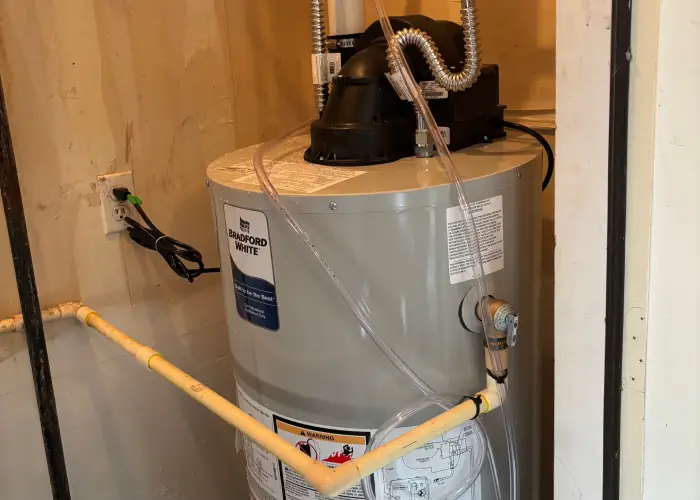
Denver Hard Water and Water Heater Sediment Buildup
Denver Water supplies water at 15 to 20 grains per gallon (GPG) of hardness across most of the metro area. Calcium and magnesium minerals dissolve in the water supply and precipitate out as the water heats inside the tank. These minerals settle at the bottom of the tank as calcium carbonate sediment.
Over time, this sediment layer hardens into a dense crust. On gas water heaters, the sediment sits between the burner and the water, forcing the burner to run longer to heat through the insulating layer. On electric water heaters, the sediment coats the lower heating element, reducing its ability to transfer heat into the water.
The consequences compound with each year of skipped maintenance:
Efficiency loss
Each inch of hardened sediment on the tank floor reduces heating efficiency by 10% to 15%. A water heater with 2 inches of sediment uses 20% to 30% more energy than a clean tank.
Popping and rumbling sounds
Water trapped beneath hardened sediment converts to steam when the burner fires. The steam pockets create popping, crackling, or rumbling sounds that indicate heavy sediment accumulation.
Accelerated anode rod depletion
Hard water minerals accelerate the electrochemical reaction that consumes the sacrificial anode rod. In Denver water, anode rods deplete in 3 to 4 years instead of the standard 5 year lifespan.
Premature tank failure
e standard 5 year lifespan. Premature tank failure. Sediment traps heat against the tank floor, overheating the steel and weakening the glass lining. This causes hairline cracks that lead to leaks at the base. A leaking tank cannot be repaired.

Complete Water Heater Maintenance Checklist
A full water heater maintenance service inspects every component that affects performance, efficiency, and safety. The checklist below covers what a licensed plumber inspects and why each item matters.
Component | Inspection Action | Why It Matters |
Tank Flush | Drain tank and flush until discharge water runs clear | Removes sediment that reduces heating efficiency and damages the tank floor |
Anode Rod | Inspect core diameter; replace when less than 1/4 inch of core remains | Protects the steel tank lining from corrosion; depletes in 3 to 4 years in Denver hard water |
TPR Valve | Lift test to confirm spring return and reseat | Safety device that releases pressure if temperature or pressure exceeds safe limits |
Expansion Tank | Check pre charge pressure; match to system pressure (40 to 80 PSI) | Absorbs thermal expansion in closed loop systems; incorrect pressure causes TPR valve discharge |
Thermostat | Verify 120F setting and calibration accuracy | Prevents overheating (safety risk) and underheating (comfort issue) |
Water Supply Connections | Inspect inlet and outlet nipples, flex connectors, and shutoff valve | Corroded nipples and degraded flex connectors are common leak sources |
Gas Connections (Gas Units) | Leak check at shutoff valve, flex connector, and gas control valve | Gas leak detection prevents fire and carbon monoxide risk |
Flue and Venting (Gas Units) | Inspect draft hood, flue pipe connections, and vent termination | Proper draft prevents carbon monoxide from entering the living space |
Tank and Fittings | Visual inspection for corrosion, mineral deposits, and moisture | External corrosion indicates internal tank deterioration; early detection prevents leaks |
For tankless water heaters, maintenance replaces the tank flush with a heat exchanger descaling procedure using food grade descaling solution. Learn more about tankless water heater repair and replacement in Denver.
How Often to Flush a Water Heater in Denver
Flush frequency depends on water hardness and whether the home has a water softener. The reference table below provides recommended intervals based on Denver metro water conditions.
Condition | Flush Interval | Notes |
Denver metro with water softener (below 10 GPG) | Every 12 months | Softener reduces mineral load; annual flush remains best practice |
Denver metro without water softener (15 to 20 GPG) | Every 12 months | Standard Denver hardness; annual flush is essential |
Areas above 20 GPG without water softener | Every 6 to 9 months | Higher hardness accelerates sediment; biannual flush recommended |
Tankless water heaters (all hardness levels) | Every 12 to 18 months | Heat exchanger descaling with food grade solution; 45 to 60 minute procedure |
Denver Water periodically flushes municipal water mains, typically in spring and fall. Main flushing stirs up sediment in city lines that enters home water heaters and accelerates buildup. Scheduling a water heater flush shortly after a municipal main flush removes this additional sediment before it hardens.
Benefits of Annual Water Heater Maintenance
Annual maintenance protects the water heater investment, reduces operating costs, and prevents emergency failures that disrupt daily routines.
- Extended Equipment Lifespan. Annual flushing and anode rod replacement extend tank water heater lifespan by 3 to 5 years. A maintained water heater reaches 12 to 15 years of service life compared to 8 to 10 years without maintenance.
- Lower Energy Bills. Removing sediment restores heat transfer between the burner or element and the water. A clean tank operates 10% to 30% more efficiently than a tank with 1 to 2 inches of sediment.
- Prevented Emergency Failures. Routine inspection identifies corroded fittings, depleted anode rods, and weakened tank linings before they cause leaks or complete system failure. Emergency replacements cost more and leave homeowners without hot water.
- Water Damage Prevention.A corroded tank or failed fitting releases 40 to 80 gallons onto floors and walls. Maintenance identifies corrosion and leak risk before a catastrophic failure occurs.
- Manufacturer Warranty Protection. Many water heater manufacturers require annual professional maintenance to keep the warranty valid. Skipping maintenance voids warranty coverage on defective tanks and components.
Our Maintenance and Flushing Process
Sewer Lines Plus follows a thorough process on every water heater maintenance service. Our estimators are not paid on commission, and our pricing is transparent with no hidden charges.
Schedule a no wait appointment
Contact our team by phone or online form. We confirm a specific arrival window so homeowners are not waiting around for a technician.
Shut down and drain the tank
A licensed plumber turns off the fuel source (gas or electric) and water supply, connects a drain hose, and flushes the tank until the discharge water runs clear of sediment and discoloration.
Inspect all components
We inspect the anode rod core diameter, test the TPR valve with a lift test, check expansion tank pre charge pressure, verify thermostat calibration at 120F, and examine all water and gas connections for corrosion or leaks.
Inspect venting and gas connections (gas units)
We check the draft hood, flue pipe, and vent termination for proper draft. We test gas connections at the shutoff valve, flex connector, and gas control valve for leaks.
Restore and test the system
We refill the tank, purge air from the lines, relight the pilot or restore power, and verify hot water delivery and temperature accuracy at fixtures. We provide a written condition report documenting every finding.
Why Denver Homeowners Choose Sewer Lines Plus
Our tagline is “ethics matter.” That philosophy shows in how we inspect, report, and maintain every water heater.
Free Estimates and Second Opinions
Every maintenance service begins with a free on site estimate. Homeowners who received a quote from another company receive a free second opinion with a detailed written comparison.
Over 800 Five Star Reviews
Denver metro homeowners have left over 800 verified five star reviews based on transparent pricing, clear communication, and thorough maintenance inspections.
No Pressure Sales
Our estimators are not paid on commission. We flush the tank, inspect every component, document the findings, and recommend only necessary work. If your water heater is in good condition, we say so.
Licensed and Fully Insured
Every plumber on our team is licensed and covered by general liability and workman’s compensation insurance.
Written Condition Report
We document every finding from the maintenance inspection in a written condition report. Homeowners know the exact status of every component, not just a verbal summary.
No Wait Appointments
. We schedule specific appointment windows so homeowners are not waiting around for a technician.
Water Heater Maintenance FAQs
How much does water heater flushing cost in Denver?
Water heater flushing in Denver typically costs $100 to $250 for a standard tank flush and inspection. Full maintenance including anode rod inspection, TPR valve test, expansion tank check, and condition report costs $150 to $350 depending on the unit type and accessibility.
How often should I flush my water heater in Denver?
Flush your water heater every 12 months in Denver. Homes with water hardness above 20 GPG or without a water softener should flush every 6 to 9 months. Tankless units require descaling every 12 to 18 months.
Can I flush my water heater myself?
Homeowners can drain and flush a tank water heater with a garden hose. However, professional maintenance includes anode rod inspection, TPR valve testing, expansion tank pressure check, gas leak testing, and venting inspection that require licensed plumbing tools and knowledge.
How do I know if my anode rod needs replacement?
A depleted anode rod shows less than 1/4 inch of core remaining when inspected. Signs include rusty or discolored hot water, a rotten egg smell (magnesium anode reacting with bacteria), or visible corrosion on the rod. In Denver hard water, anode rods typically need replacement every 3 to 4 years.
Does water heater maintenance extend the lifespan?
Yes. Annual flushing and anode rod replacement extend tank water heater lifespan by 3 to 5 years. A maintained tank reaches 12 to 15 years compared to 8 to 10 years without maintenance.
Does Sewer Lines Plus maintain tankless water heaters?
Yes. Tankless maintenance includes heat exchanger descaling, inlet filter cleaning, flame rod inspection (gas units), and flow sensor check. Learn more about tankless water heater repair and replacement in Denver.